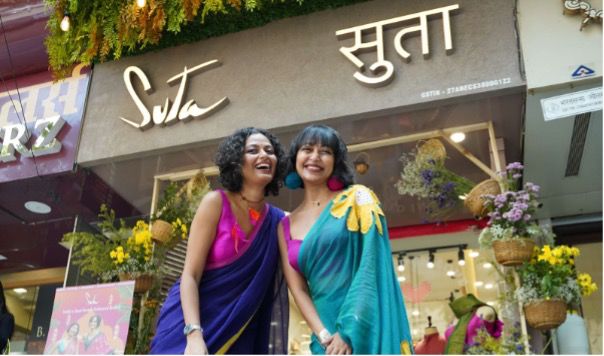
In 2016, Sujata and Taniya Biswas resigned from their corporate careers at Essar, IBM, and IIT Bombay with ₹6 lakh in savings and a shared love for handwoven sarees. Today, Suta is a fully bootstrapped ₹75 crore brand, working with 17,000 artisans across India, running 15 stores, and building toward an IPO.
Their mother wore them. Their grandmother collected them. And an entire generation of young Indian women had quietly stopped draping them because nobody had made the saree feel like theirs.
Two sisters from Bengal looked at that gap — and chose to fill it with thread, stories, and an unshakeable belief in Indian craft. No investors. No fashion background. Just ₹6 lakh, one weaver named Gopida, and a name that meant everything.
The name Suta is a portmanteau of Su from Sujata and Ta from Taniya, and it also means thread in Sanskrit. It was, as the sisters describe it, a fairy-tale coincidence. A brand name that carried both identity and purpose in a single syllable. That is where it begins.
The Origin — Corporate Careers, One Bold Resignation, and a Weaver Named Gopida
• Sujata earned her engineering degree from CET Bhubaneswar and her MBA from IIFT Delhi, spending seven years across Essar Group and Jindal Group before pursuing a PhD in e-commerce at IIT Bombay. Taniya, an engineer and IIM Lucknow graduate, worked with the Tata Group and IBM as a consultant. Between them, they had elite pedigree, stable salaries, and every reason to stay in the corporate world.
• They chose otherwise. On April 1, 2016, both sisters resigned from their corporate jobs and dedicated themselves entirely to building Suta, with a mission to positively impact weaver and artisan communities and ensure traditional crafts thrive.
• They started working with one weaver, whom they fondly called Gopida, and his daughter-in-law. Their first collection was the Made-in-Heaven Mul sarees. In those days they would get one saree every three to four days, and Gopida's daughter-in-law would hand-make the pom-poms. From one weaver in a village in West Bengal to a network spanning Varanasi, Odisha, Kutch, Meghalaya and Kashmir. That is the arc of Suta's supply chain story — built relationship by relationship, village by village.
The Strategic Genius — Stories Stitched Into Every Saree
• The boldest decision Suta ever made had nothing to do with pricing or distribution. It was about meaning.
• Every single product at Suta carries a unique name and a background story. The founders believe that when you have a product with a name, you will keep it and talk about it. "When we were kids, we never threw away the dresses our mothers or grandmothers made, but we discarded the store-bought ones. When your blouse has a name, you will keep it and talk about it," says Sujata.
• Sarees named Violaceae, Desert Rose, Kalo Jonaki, Cinnamon Dust. Each one a piece of literature as much as a piece of fabric. Customers buy products that they share their names with. "A lady called Rekha bought all the Rekha sarees!" the founders share.
• The brand also did something no competitor had done before: they included the falls, the fabric sewn to the hem of the saree to help with draping, already done in every piece. The notion in the market was that falls already being done meant the product was old. Suta took the risk and customers loved it. Two decisions rooted entirely in understanding the customer more deeply than anyone else in the category.
• Everything behind the scenes at Suta is managed in-house today — warehouses in Mumbai and Kolkata, digital marketing, content, design, and product shoots — giving operations control and a personal touch, allowing the team to correct mistakes fast.
Scale, Numbers and Real-World Impact
• Annual revenue of Suta stands at ₹73.5 crore as of March 31, 2025, with 231 employees as of October 2024. The brand recently launched its 15th store in Bengaluru, manages over 5,000 SKUs, and works with 17,000 artisans and weavers across India.
• Suta engages the entire weaver family, not just the primary artisan. Daughters and mothers make tassels, wives place tags, and sisters handle pre-washing. It is a community economy built around a single brand.
• The brand has been recognised by Vogue India, Elle, Harper's Bazaar, and The Economic Times, and the founders are eyeing an IPO as their next milestone. Saree prices range from ₹1,500 to ₹50,000, with the franchise-led offline model costing ₹30 to ₹35 lakh per store with a revenue share structure.
• And still, Suta remains a bootstrapped fashion brand with zero external funding. In a startup ecosystem obsessed with funding rounds and valuation milestones, that is the most radical statement of all.
The Business Lesson — Community Is the Only Moat That Compounds Forever
• The sharpest lesson from Suta's journey is this: the most durable consumer brands are the ones that make customers feel like they belong to something larger than a product.
• Customers do not just buy a product at Suta. They become part of the Suta family. Many proudly call themselves "Suta Queens," a nod to the connection they feel with the brand and with each other.
• Sujata and Taniya did not build a fashion label. They built a community, stitched together by stories of weavers, childhood memories, and the quiet conviction that a handwoven saree deserves to be worn on a Tuesday, not just a wedding day. That conviction, held consistently and communicated honestly for nine years, has built something that ₹75 crore in revenue alone could never fully measure.
• "When we started Suta, we figured that we can touch lives in the villages where the crafts are dying, where the art form is not as appreciated," Sujata reflects. They have. And in doing so, they built one of India's most loved fashion brands — thread by thread, story by story, entirely on their own.
Sources: YourStory, Business Today, The Better India, Suta Official Website, Tracxn, Shopify Masters, StartupPedia