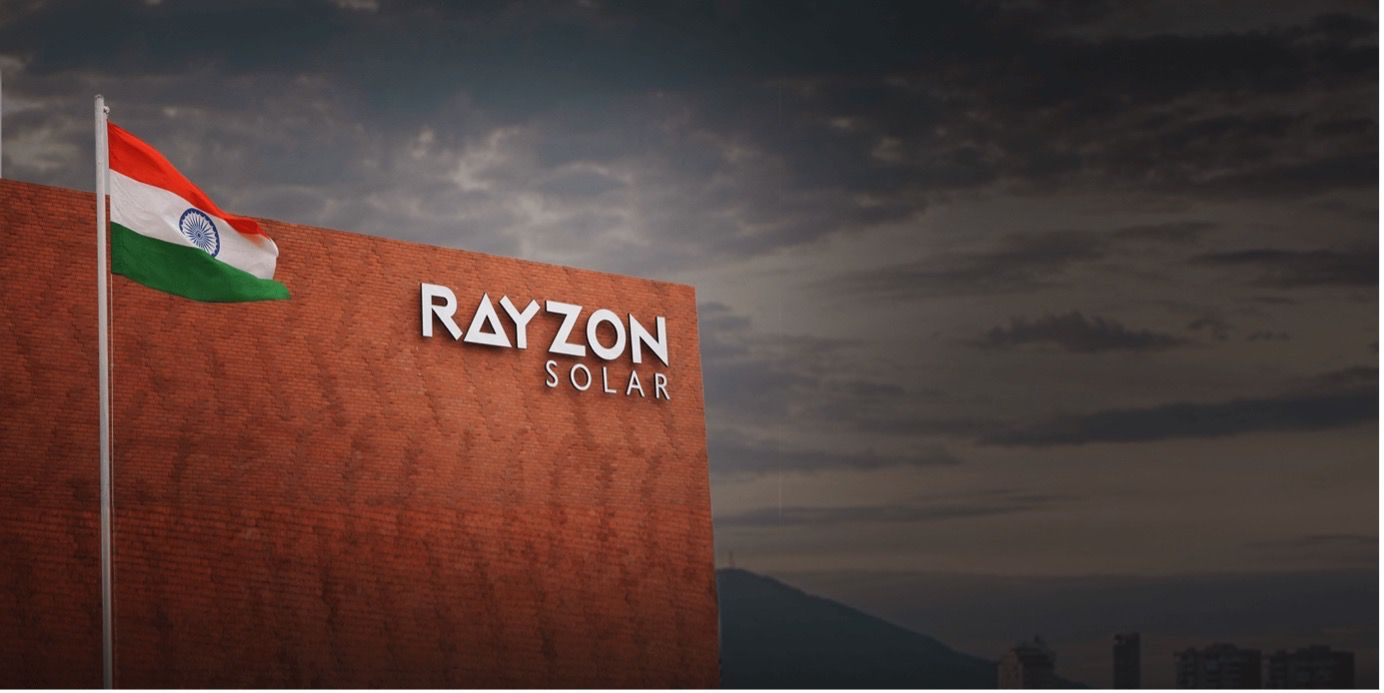
In 2017, two friends from Surat — Hardik Kothiya and Chirag Nakrani — co-founded Rayzon Solar with zero background in solar manufacturing and a production unit making just 100 panels a day. Eight years later, they command a ₹7,000 crore company, 6 GW of production capacity, and exports across 17 countries.
Two young men from Surat looked at the sun, and decided to build a business around it.
They had no engineering background in solar. They had no big investors. They had no roadmap drawn by industry veterans. WhaRayzon Solar has grown exponentially and has become a leader in solar panel manufacturing. From an initial turnover of ₹1 crore in 2017, the company has projected revenue of ₹3,000 crores by 2024. And the two co-founders at the centre of it all — Hardik Kothiya and Chirag Nakranianel manufacturing. From an initial turnover of ₹1 crore in 2017, the company has projected revenue of ₹3,000 crores by 2024. And the two co-founders at the centre of it all - Hardik Kothiya and Chirag Nakran built every single milestone from the ground up, together.
The Origin Story : One Idea, One Partnership, and 100 Panels a Day
Chirag Nakrani grew up in a business family, with his father engaged in real estate. Although the business was stable and successful, Chirag felt a void due to a lack of innovation and creativity. He wanted to push himself and create something that could be beneficial for society. In 2017, he partnered with his friend Hardik Kothiya, and they formed Rayzon Solar.
Hardik Kothiya was born in 1994 into a business-oriented family and raised in Surat, Gujarat. With over eight years of experience in actively managing key business activities like strategic planning, production, and international businesses, he has demonstrated his entrepreneurial skills and innovative thinking. The two friends had complementary instincts - Hardik's focus on production, strategy, and operations, and Chirag's drive toward sales, international business development, and market expansion.
With absolutely no background in the solar industry, Chirag and other members were able to establish Rayzon Solar starting from scratch with the help of a 100-solar-panel-per-day small-scale manufacturing unit. Rayzon Solar was established in 2017, starting with a production capacity of 40 megawatts. In its first year, the company generated revenue of approximately ₹1 crore.
One crore rupees. One hundred panels per day. Two friends who had done their research on future industries and arrived at the same answer: renewable energy was the sector that would define the next generation — and they intended to lead it.
The Defining Turn - Doubling Down, Again and Again
What separates Rayzon Solar from dozens of solar startups that came and went in the same period is not the idea — it is the relentless, almost aggressive pace at which the two co-founders chose to scale.
In very short intervals, Rayzon expanded its production capacity nearly threefold - which is again a remarkable achievement in the solar industry. Within a year, Rayzon realised the industry trend and expanded its capacity nearly double to meet market demand. Again within a year, - Rayzon realised the industry trend and expanded its capacity to meet growing demand. This was a pattern they repeated, year after year, trusting the market signal and committing capital and capacity ahead of demand rather than behind it.
Chirag built his reputation as an honest businessperson with good values and an easygoing approach towards customers. He strongly believed in taking calculated risks, adapting to market changes, and always prioritising customers' happiness. Meanwhile, Hardik was building the operational and production backbone, the manufacturing systems, the supply chain discipline, and the quality standards that would eventually earn Rayzon Solar its position as a globally trusted brand.
Rayzon Solar was the first in India to adopt TOPCon technology, which enhances the efficiency and performance of solar panels. The company's manufacturing facility is fully automated, ensuring precision and quality in every product. Being first to adopt a superior technology - before competitors had even evaluated it - gave Rayzon a product edge that compounded over time into a market position that incumbents struggled to replicate.
The Strategic Genius: Backward Integration, TOPCon First, and the IPL Play
The most strategically significant decisions Hardik and Chirag made were the ones designed to give Rayzon control over its own destiny, rather than remaining dependent on external supply chains or commodity pricing.
The company has taken strategic steps like backward integration with aluminium extrusion and anodising facilities, ensuring greater control over its supply chain, a key factor in its competitive edge. In a manufacturing business where margins are constantly under pressure from raw material costs and global supply volatility, owning key parts of the production chain is the difference between a business that survives disruption and one that is undone by it.
The second stroke of genius was cultural and brand-driven. Rayzon Solar formed strategic partnerships with two leading IPL teams: Gujarat Titans and Chennai Super Kings, establishing itself as a renewable energy partner. Through these partnerships, Rayzon Solar aimed to raise awareness about renewable energy and encourage its adoption. In a country where cricket is a religion and IPL is its grandest ritual, associating a solar brand with two of its most beloved teams was a master class in mass-market brand building. Rayzon Solar was no longer just a B2B manufacturer, it was a name that millions of cricket fans saw on their screens.
And then came Shark Tank India Season 5. Even after establishing a successful business with a turnover of ₹2,830 crore, Hardik realised that many people were still unaware of his brand, its impact, and contribution to sustainable energy solutions. His decision to appear on Shark Tank India Season 5 was not just about funding , it was a strategic move for PR and brand marketing. He did not go to the Tank to raise capital. He went to ensure that every household in India knew what Rayzon Solar had built.
Scale, Numbers & Global Impact
Annual revenue of Rayzon Solar is ₹2,830 crore as on March 31, 2025. The company closed FY 2023–24 with a revenue of ₹1,400 crores. The trajectory from ₹1 crore in Year 1 to ₹2,830 crore in Year 8 is among the most dramatic growth curves in Indian manufacturing history.
Production capacity rose from 2.1 GW at the end of fiscal 2024 to 6 GW at the end of fiscal 2025, with 3 GW commissioned in March 2025 alone. Rayzon Solar's manufacturing capacity has also increased to 4 GW, with plans for further expansion to 13 GW in phased development by 2026. In just seven years, Rayzon Solar has become one of the top 3 solar panel manufacturing companies in India.
Rayzon Solar has raised $16.2 million in funding over one round from 84 investors. The company has 1,196 employees as of April 2025, a 59% increase from April 2024. Operating in over 17 countries, including the United States, Europe, and the Middle East, Rayzon Solar has established itself as a global leader.
Hardik Kothiya, at 31, has been recognised as the youngest entrepreneur on the Avendus Wealth, Hurun India U35 List. With a net worth of ₹3,970 crore, Hardik Kothiya is among the youngest billionaires in India and the richest judge on Shark Tank India Season 5. The total company valuation stands at approximately ₹7,000 crore, a figure built entirely through manufacturing excellence, strategic expansion, and two co-founders who trusted each other and the power of the sun.
Awards and recognition have followed: Rayzon Solar was awarded in the ELLE Sustainability Awards 2025 for its environmental stewardship and community involvement, and won the Green Gujarat Award in 2024 for sustainable innovation.
The Business Lesson: Build Before the World Is Ready. Scale Before You Are Comfortable.
The sharpest insight from Rayzon Solar's journey is this: the founders who win in transformational industries are the ones who commit before the market has fully arrived.
In 2017, solar energy in India was growing but it was far from the mainstream conversation it is today. Hardik and Chirag looked at the trajectory, believed in the destination, and started building the infrastructure to serve a demand that was still arriving. By the time the demand became undeniable, Rayzon was already positioned, scaled, and ready.
Mr. Chirag's entrepreneurial journey was far from easy. With no technical background in solar manufacturing, he faced numerous obstacles, from assembling a skilled team to mastering the intricacies of solar technology. Through perseverance and strategic thinking, he overcame these hurdles, building a diverse and competent workforce while fostering a culture of innovation.
The second lesson is about the power of co-founder complementarity. Hardik and Chirag brought genuinely different skills to the same table - production and strategy on one side, sales and international business on the other. Neither could have built Rayzon alone. Together, they built one of India's fastest-growing solar companies. The right partnership, structured around clear roles and shared values, is worth more than any single stroke of individual genius.
And the third lesson is one that Hardik demonstrated personally, by stepping onto the Shark Tank India Season 5 panel: even at ₹2,830 crore in revenue, brand awareness still matters. Visibility and profitability are not competing priorities, they are compounding ones.
The Bigger Picture: Surat Is Becoming India's Solar Capital
Surat has long been known as India's diamond city and textile hub. Hardik Kothiya and Chirag Nakrani are writing a new chapter for the city - one powered not by diamonds or looms, but by photons.
Companies which have contributed to increasing India's domestic manufacturing capacity of solar modules to 100 GW include Rayzon Solar, among others. India added 11 GW of solar in Q1 of FY26 - the highest ever. Rayzon Solar is a central part of this national story.
The aim is to achieve 9 GW production capacity to serve green energy demand internationally. With 6 GW already operational and a target of 13 GW in phased development, the ambition is not to be a leading Indian solar company: it is to be a globally significant one.
Two friends sat down in 2017 and did the math. They looked at where India was going, where the world was going, and where the sun rose every single morning without exception. They chose to build for that certainty. Eight years later, they are powering homes, businesses, and an entire nation's clean energy ambition — from a city known for its diamonds, with a company that now shines just as bright.
The sun, as it turns out, was always the right bet. Hardik Kothiya and Chirag Nakrani simply had the courage to build on it together.
Sources: Rayzon Solar Official Website, StartupTalky, Tracxn, Industrial Outlook, Renewable Mirror, Rayzon Solar Blog, ScanX / Hurun India, DNA India, News24, CRISIL Ratings, Dcrayons, Down to Earth, Wikipedia