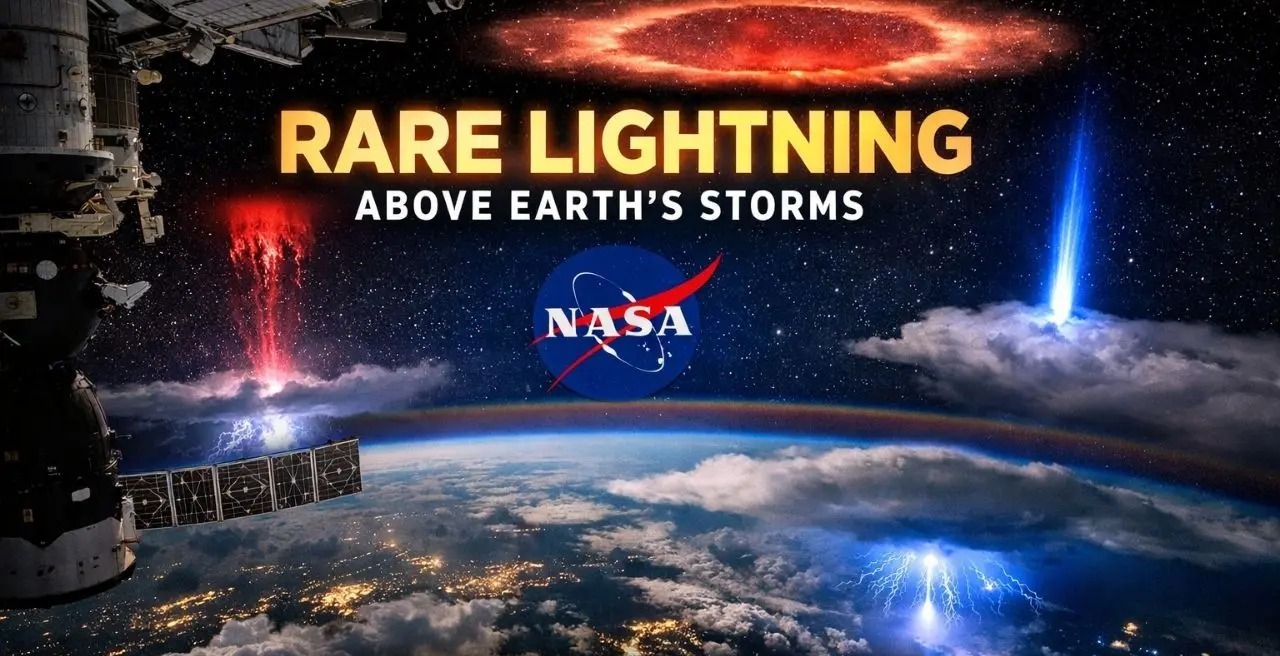



Astronauts aboard the International Space Station have photographed extraordinary transient luminous events (TLEs) high above Earth’s thunderstorms. These rare flashes red sprites, blue jets, violet halos occur nearly 55 miles above the surface and last only milliseconds, but from orbit they appear as surreal fireworks illuminating the edge of space.
Extraordinary Event Witnessed From Orbit
NASA released the images this week, confirming that astronauts observed bizarre lightning storms invisible from the ground. The ISS’s vantage point allows scientists to study these elusive phenomena systematically, using specialized cameras and sensors to capture every fleeting spark.
Understanding Transient Luminous Events
For decades, pilots reported strange flashes above storms, but they remained poorly documented. Now, with ISS observations, researchers can analyze how TLEs form, their role in Earth’s upper atmosphere, and their potential impact on climate and electrical systems. These events highlight the complexity of atmospheric science and the hidden dynamics of storms.
Scientific Significance
The discovery underscores the importance of orbital research in revealing phenomena beyond human reach. By studying TLEs, scientists hope to better understand atmospheric electricity, improve weather models, and explore how energy transfers between Earth and space.
Key Highlights
-
NASA shares rare photos of transient luminous events (TLEs)
-
Phenomena include red sprites, blue jets, violet halos, ultraviolet rings
-
Occur up to 55 miles above Earth’s thunderstorms
-
Captured by astronauts aboard the International Space Station
-
Findings enhance understanding of atmospheric electricity and storm dynamics
Sources: Earth.com, Euro Weekly News, NewsBreak