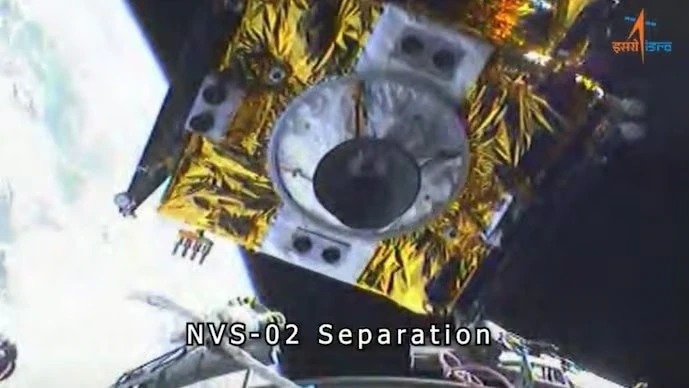





A year after the failure of India’s NVS-02 navigation satellite, ISRO has revealed that the anomaly was caused by a pyro valve signal loss during orbit-raising operations. The engine could not be fired to shift the satellite into its intended orbit, leading to mission failure despite successful launch separation.
The Indian Space Research Organisation (ISRO) has released findings from an apex committee investigating the failure of the NVS-02 satellite, launched on January 29, 2025. While the spacecraft was successfully placed into its transfer orbit, subsequent orbit-raising maneuvers failed due to a technical anomaly.
According to ISRO, the issue was traced to a pyro valve signal loss in the oxidiser line of the engine. This prevented the engine from firing, thereby stopping the satellite from reaching its intended circular orbit. Despite successful solar panel deployment and stabilization, the mission could not proceed as planned.
ISRO emphasized that corrective measures are being implemented to prevent recurrence in future missions, ensuring reliability in India’s navigation satellite program.
Key Highlights:
-
Launch Success: NVS-02 injected into transfer orbit on Jan 29, 2025.
-
Failure Cause: Pyro valve signal loss in oxidiser line.
-
Impact: Engine could not perform orbit-raising maneuver.
-
Committee Findings: Apex panel traced anomaly to pyro system.
-
Future Measures: ISRO implementing corrective steps for upcoming missions.
This explanation provides clarity on the setback and reinforces ISRO’s commitment to strengthening India’s satellite navigation capabilities.
Sources: India Today, Times of India, ISRO Official Release