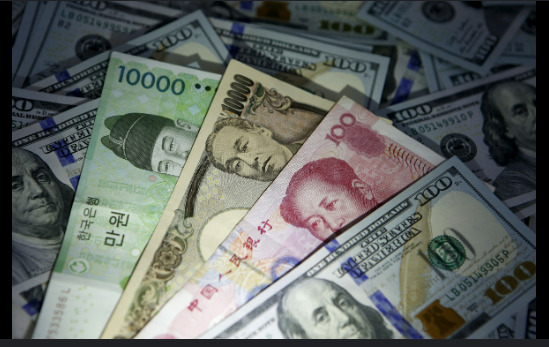




Currency market positioning shows investors maintaining long bets on the Malaysian ringgit and Chinese yuan, while bearish sentiment grows against the Taiwan dollar, Indian rupee, and Indonesian rupiah. Short bets on the South Korean won have climbed to a six-week high, reflecting global uncertainty and shifting investor strategies.
Investor sentiment in Asian currency markets has shifted significantly, with traders maintaining long positions on the Malaysian ringgit (MYR=) and Chinese yuan (CNY=CFXS). At the same time, bearish bets have increased against the Taiwan dollar (TWD=TP), Indian rupee (INR=IN), and Indonesian rupiah (IDR=), highlighting concerns over regional economic pressures.
According to market data, short positions on the South Korean won (KRW=KFTC) have surged to their highest level in six weeks. Analysts attribute this trend to global economic uncertainty, fluctuating commodity prices, and geopolitical developments that continue to weigh on investor confidence across emerging markets.
Key Highlights
-
Investors stay long on Malaysian ringgit and Chinese yuan
-
Bearish bets rise on Taiwan dollar, Indian rupee, and Indonesian rupiah
-
Short positions on South Korean won climb to six-week high
-
Market sentiment reflects global uncertainty and regional economic pressures
-
Currency positioning highlights investor caution amid volatile conditions
Market Context
Experts note that while the yuan and ringgit benefit from relative stability and supportive policy measures, currencies like the rupee and rupiah remain vulnerable to external shocks. The rise in short bets on the won underscores investor caution toward South Korea’s export-driven economy amid global demand concerns.
Sources: Reuters