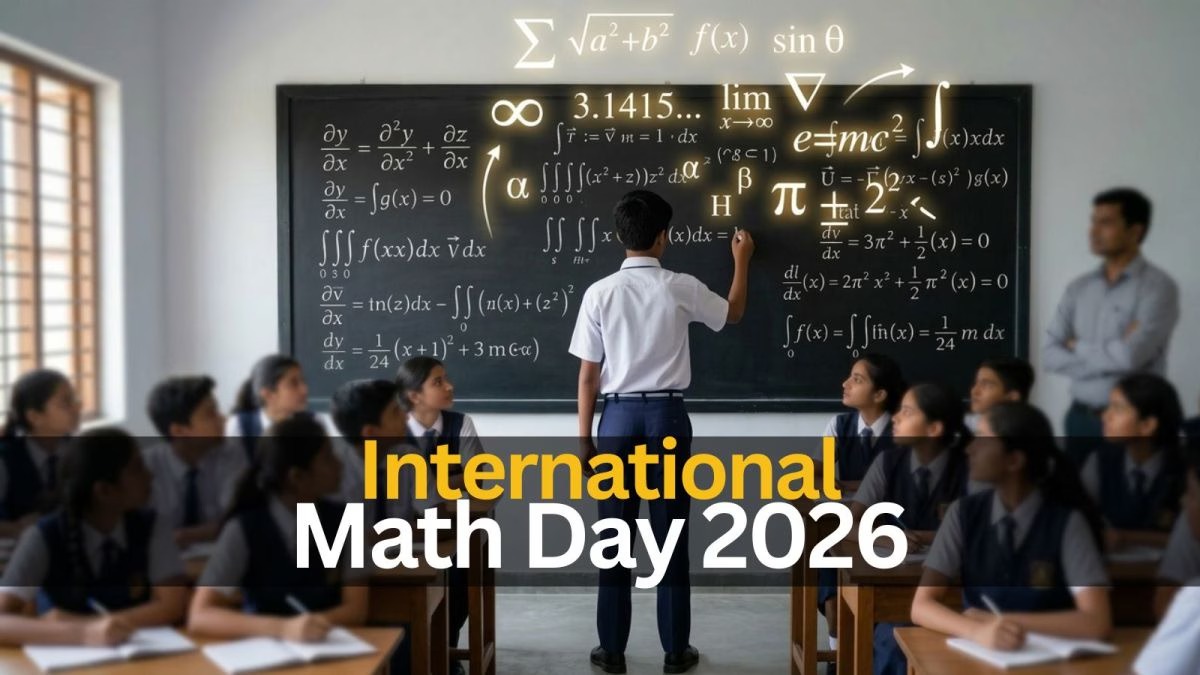
Today, March 14, 2026, the world marks International Mathematics Day — better known as Pi Day — under the theme "Mathematics and Hope." From San Francisco's famous Pi Parade to UNESCO-backed global events, this annual celebration of π honours the infinite, irrational constant that silently governs everything from pizza crusts to planetary orbits.
Every year on March 14, the date itself becomes the message. Pi Day 2026, also known as the International Day of Mathematics, is observed on March 14, 2026 (3/14), because the first three digits of the mathematical constant Pi are 3.14. What began as a quirky museum tradition nearly four decades ago has since grown into a globally recognised celebration of mathematical curiosity, creativity, and the profound role numbers play in shaping the world.
A Holiday Born From A Parade And A Slice Of Pie
The first large-scale celebration of Pi Day was organised in 1988 by Larry Shaw, a physicist at the San Francisco Exploratorium, who marched colleagues around the museum's circular Pi Shrine while everyone enjoyed slices of fruit pie — linking the homophone "pi" with the circular dessert in a tradition that quickly spread to classrooms nationwide.
Official recognition came in 2009 when the United States House of Representatives passed a non-binding resolution designating March 14 as National Pi Day, and in 2019, UNESCO expanded the celebration's global reach by proclaiming the date as the International Day of Mathematics.
This Year's Theme: Mathematics And Hope
The 2026 global theme, "Mathematics and Hope," is a powerful reminder of how math builds connection, drives innovation, and offers solutions to the world's biggest challenges — showing how a single number can inspire hope through discovery, creativity, and problem-solving.
The theme carries timely weight. From AI systems and climate modelling to vaccine development and space exploration, mathematics underpins nearly every solution humanity is reaching for in 2026.
What Makes Pi So Endlessly Fascinating
Pi represents the ratio of the circumference of a circle to its diameter and has been calculated to over 50 trillion digits beyond its decimal point — and as an irrational and transcendental number, it continues infinitely without repetition or pattern.
The most significant pi research in history came from the astronomer Archimedes around 250 B.C., whose mathematical calculation showed that pi fell between precise fractional boundaries — a finding that laid the foundation for millennia of mathematical exploration that followed.
March 14 also marks the birthday of Albert Einstein, born on March 14, 1879, giving the date dual significance as both a mathematical and scientific milestone in human history.
How The World Is Celebrating Today
The Exploratorium in San Francisco is hosting its 39th annual Pi Day celebration today from 11:00 a.m. to 4:30 p.m., featuring math-inspired activities, presentations, a Pi Procession parade through the museum, and a free slice of pie for all participants following the march.
Globally, the International Day of Mathematics invites all countries to participate through activities for students and the general public in schools, museums, libraries, and other community spaces, with the IDM's interactive map tracking events happening simultaneously around the world.
Digits Worth Knowing: The Pi Day Fact Sheet
March 14 written as 3/14 mirrors the first three digits of π — 3.14
Pi Day 2026 falls on a Saturday, giving families, schools, and science centres additional time to host weekend-long workshops, events, and parades
At exactly 1:59 p.m. today, enthusiasts worldwide observe the "pi moment," marking the next three digits of pi — 1, 5, and 9 — with a toast, a cheer, or the first ceremonial bite of pie
Pi has been calculated to over 50 trillion decimal places and still shows no repeating pattern
Pi 5K runs covering approximately 3.14 miles are a popular way to combine fitness with mathematical celebration worldwide
The IDM is a project led by the International Mathematical Union with the support of numerous international and regional organisations
Albert Einstein was born on March 14, 1879, adding a second reason to celebrate mathematical genius today
Why It Matters Beyond The Pie
Pi Day provides a unique cultural bridge between the abstract world of mathematics and everyday life, encouraging curiosity about the universe, as π is essential for everything from calculating the orbits of planets to designing the technology in modern smartphones. Today is not merely about memorising digits — it is an invitation to see the infinite elegance hiding inside the everyday, one circle at a time.
Sources: International Day of Mathematics (idm314.org), Exploratorium San Francisco, UNESCO, NBC New York, Vedantu, PiDay.org, Holiday Today, Boston Today, Nine Planets