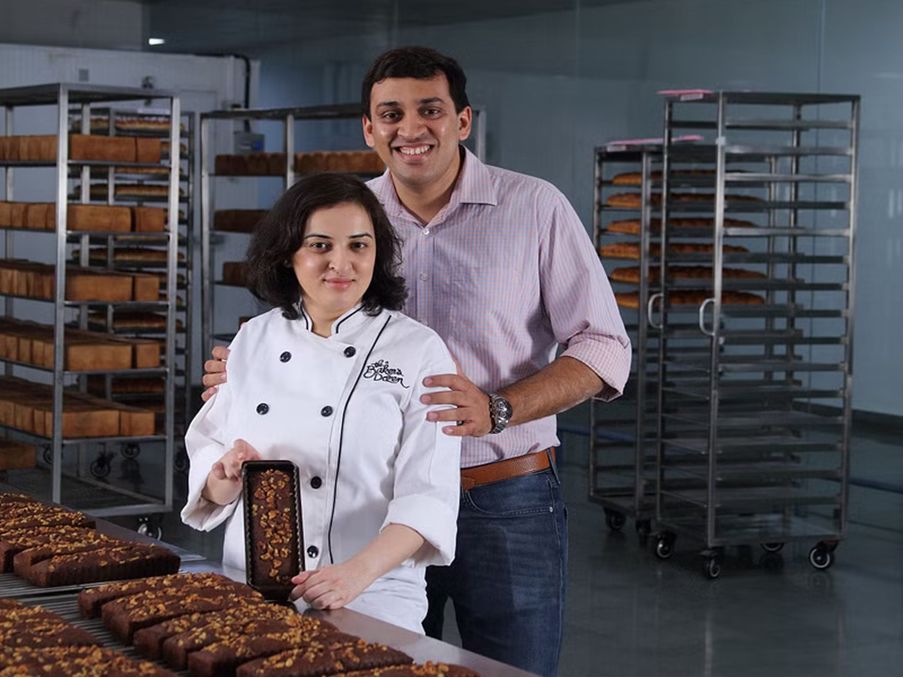

Aditi Handa and Sneh Jain co-founded The Baker's Dozen in Mumbai in 2013 with no food industry background, starting with 25 loaves a day from a small kitchen. Today India's largest artisan bakery, the brand generates ₹84.2 crore in annual revenue, operates across 33 cities and 2,000 touchpoints, and has raised $9 million in total funding.
A Psychology Graduate Who Went to New York and Paris to Learn How to Bake Bread
• Aditi Handa was born in Ahmedabad and grew up in a family of entrepreneurs. Her father ran a successful pharma company. Her mother adopted a village and taught women embroidery and stitching. Entrepreneurship was the language of her household. But Aditi herself had always been drawn to food through her years in England, attending chef sessions, eating at restaurants, following culinary work with the same intensity she had brought to her academic life.
• When she and her husband Sneh Jain decided to build a business together after returning to India, they knew it had to be in food. Once sourdough claimed her in 2012, Aditi flew to New York to earn a Diploma in International Bread Baking from the International Culinary Centre, and then to Paris to earn a Diploma in Patisserie from Le Cordon Bleu. Her teacher in New York, Chef Johnson, shaped not just her technical skills but her philosophy: honest ingredients, proper fermentation, no stabilisers, no preservatives, no shortcuts.
• Sneh Jain, an IIM Ahmedabad graduate, brought the business architecture that would turn a beautiful craft into a scalable company. Together they launched The Baker's Dozen in 2013 from a small kitchen and single store in Prabhadevi, Mumbai.
Day one: 25 loaves of bread.
Take Sourdough to the Kirana Store
• The boldest decision The Baker's Dozen made was the one most artisan brands would consider unthinkable: bring premium sourdough to mass retail.
• At a time when sourdough was considered a luxury product, confined to upscale restaurant menus and home baker circles, Aditi had a completely different vision. "I wanted to bring it out of the elitist closet," she says. "When I started, the idea was simple: to bring sourdough back as a daily essential."
• The education was hands-on and personal. When Aditi launched the Kemps Corner store in Mumbai, she would hand customers a free loaf alongside their purchase. "Aunty, try this, I know you'll like it," she told hesitant shoppers. That approach, one customer, one loaf, one conversation at a time, built the trust that no amount of advertising could replicate.
• The manufacturing decision matched the philosophy. Every product is made at The Baker's Dozen's own 25,000 square foot factory in Ahmedabad, dispatched three times a week to warehouses, and delivered daily to stores. No outsourcing. The product is too technical, the standards too precise, for any other approach.
• Germany's Modified Atmosphere Packaging technology, which The Baker's Dozen pioneered in India's bakery industry, extended shelf life without compromising on the clean ingredient list. It was the innovation that made nationwide distribution possible without betraying the artisan promise.
• When the pandemic arrived in 2020 and home baking surged across India, The Baker's Dozen was already perfectly positioned. People who attempted sourdough at home realised how technically demanding it was, and turned to the brand that had been doing it correctly since 2013. Orders that had started at 12 per day scaled dramatically. The brand's production has grown from 1,000 loaves in its first year to 1 lakh in five years to 3 lakh-plus annually.
Scale, Numbers and Real-World Impact
• The Baker's Dozen generated annual revenue of ₹84.2 crore for the financial year ending March 31, 2025. The brand has raised $9 million in total funding across three rounds, with investors including Fireside Ventures, Wipro Consumer Care Ventures, She Capital, Alteria Capital, and Mirabilis Investment Trust. The most recent funding round of ₹33 crore was closed in January 2024. The brand is present across 33 cities and 2,000 touchpoints in India, including 50 of its own stores, 600 modern and general trade stores, and all major e-commerce and quick commerce platforms including Amazon, Flipkart, Blinkit, Zepto, Swiggy, Zomato, and Big Basket. The company has 122 employees and operates India's first pandemic-ready 25,000 square foot baking factory in Ahmedabad. The brand's Zero Maida whole wheat sourdough loaf is currently its biggest-selling product.
Depth Before Breadth: Master One Product Until It Changes a Culture
• The sharpest lesson from The Baker's Dozen's journey is this: the most transformative consumer brands are built by people who go deep into one product with absolute conviction, and stay there long enough to shift an entire market's behaviour.
• Aditi Handa did not start with a diverse product range. She started with sourdough. She trained for it, perfected it, and then spent years patiently educating a country that had forgotten what honest bread tasted like.
• "Start small and perfect your product with customer feedback in a limited area," she advises. "Do not be married to your product. But do be married to your quality."
• From 25 loaves in a Prabhadevi kitchen to India's largest artisan bakery across 33 cities, The Baker's Dozen is the story of what happens when a founder with no background in the industry falls completely, irrevocably in love with the craft.
• That love, it turns out, is more durable than any business plan.
Sources: The Baker's Dozen Official Website, Tracxn, YourStory, The Hindu, Global Indian, Local Samosa