
Ayush Varma founded Ravel, now Ravelcare Limited, in Mumbai in 2021 after travelling across India and observing how one-size-fits-all hair products were failing millions of people. He appeared on Shark Tank India Season 2, secured ₹75 lakh from Anupam Mittal, scaled to ₹24.97 crore in FY25 revenue, and listed on BSE SME in December 2025.
A Computer Engineer Who Became a Hair Care Revolutionary
Ayush Varma completed his Computer Engineering degree at KJ Somaiya College in Mumbai and chose entrepreneurship immediately after graduation. His post-college journey across India revealed a structural problem in the hair care industry: India's extraordinary diversity in climate, diet, water quality, and lifestyle produced an equally extraordinary diversity in hair types, issues, and needs. And yet every shelf in every pharmacy sold the same products to everyone.
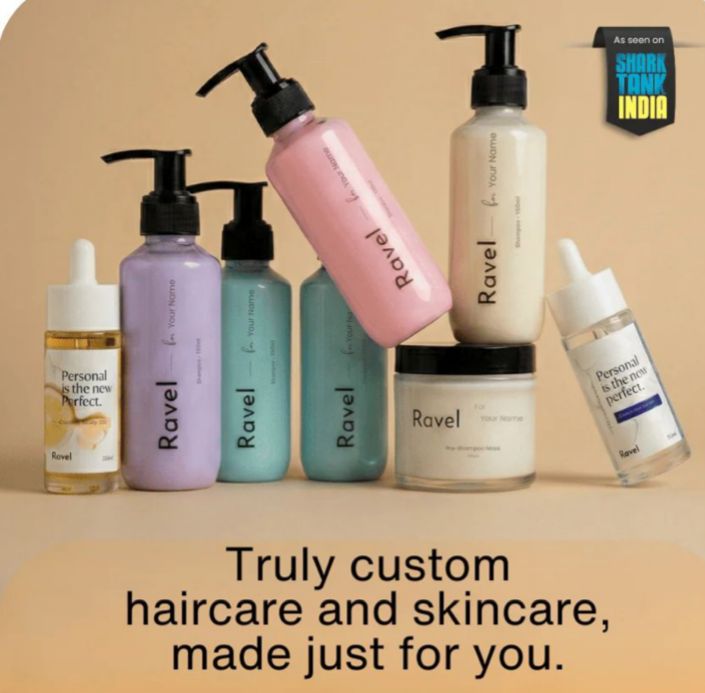
Ravel was born in January 2021 to answer this exact problem. Incorporated as Ravelcare Limited and headquartered in Malad West, Mumbai, the brand built its entire foundation on personalisation: a detailed science-backed questionnaire covering gender, hair type, lifestyle, stress levels, specific hair concerns, and their intensity. Based on these responses, a custom-formulated product was created for each individual customer.
All products are manufactured in India, free from sulfates, parabens, phthalates, and cruelty. The brand positioned itself at the intersection of two powerful consumer trends: the demand for personalisation and the shift toward clean, ingredient-transparent beauty.
50 Billion Combinations and a Made-to-Order Model
The boldest decision Ravel made was also its most technically ambitious: instead of building a catalogue of products and asking customers to choose, it built a system where the product is built for the customer.
Ravel combines customer input with the expertise of hair professionals, resulting in 50 billion unique product combinations. The made-to-order approach means every bottle of shampoo, conditioner, serum, or hair oil that leaves Ravel's facility was created for a specific person with a specific set of hair concerns. This is the opposite of how the hair care industry has operated for decades.
The go-to-market strategy was digital-first. With no retail overhead and a D2C model that allowed direct customer feedback, Ravel was able to iterate quickly, build repeat purchase behaviour, and gather proprietary data on Indian hair concerns at a scale that no traditional brand could match.
The Shark Tank Moment and the IPO That Followed
Ravel's national turning point came on Shark Tank India Season 2. Ayush pitched the vision of personalised haircare to a panel that included Anupam Mittal, who called the timing and opportunity compelling. Ayush asked for ₹75 lakh for 2.5% equity. After negotiation, he accepted Anupam's conditional offer of ₹75 lakh for 7.5% equity, contingent on achieving a monthly profit of ₹7.5 lakh within two months. The deal closed after the show.
Post-Shark Tank, brand awareness surged, digital traffic accelerated, and Ravelcare's customer base crossed 2 lakh users. The brand's monthly net profit at the time of the show was ₹5.5 lakh, and the annualised revenue run rate was approximately ₹5 crore.
Then came the most remarkable chapter of all. In November 2025, Ravelcare Limited announced an IPO on BSE SME, raising capital through a fresh issue of up to 18,54,000 shares at ₹130 per share, aggregating to ₹24.10 crore. The listing was on December 8, 2025, making Ravelcare one of the few Shark Tank India companies to progress from a television pitch to a public market listing.
Scale, Numbers and Real-World Impact
For the full financial year 2025, Ravelcare reported revenue of ₹24.97 crore and profit after tax of ₹5.25 crore. For the six months ended September 30, 2025, revenue was ₹14.39 crore and PAT was ₹3.19 crore. The company has over 2 lakh lifetime customers, is available pan-India through its digital platform, and has ambitions for global expansion. The IPO issue price of ₹130 per share was set for BSE SME, with listing completed in December 2025.
Personalisation Is the Most Defensible Moat in Consumer Brands
The sharpest lesson from Ravel's journey is this: in a world of commoditised products, the most defensible position is the one that serves a specific person rather than a generic category.
Every hair care brand in India sells to "the person with dry hair." Ravel sells to a specific person: their gender, their city, their diet, their stress levels, their lifestyle, their exact concern. That specificity creates a product experience so personal that the probability of switching to a generic alternative feels low by comparison.
Ayush built 50 billion product combinations not because it was easy. He built them because the customer deserved that level of care. And the market, from Shark Tank to the BSE SME exchange, agreed.
He observed. He questioned. He built. And then he listed. That is one complete entrepreneurial arc, built from a post-graduation road trip across India.
Sources: StartupPedia, FirstIndia, WeRiseByLiftingOthers.in, Shark Tank India Club, Tracxn