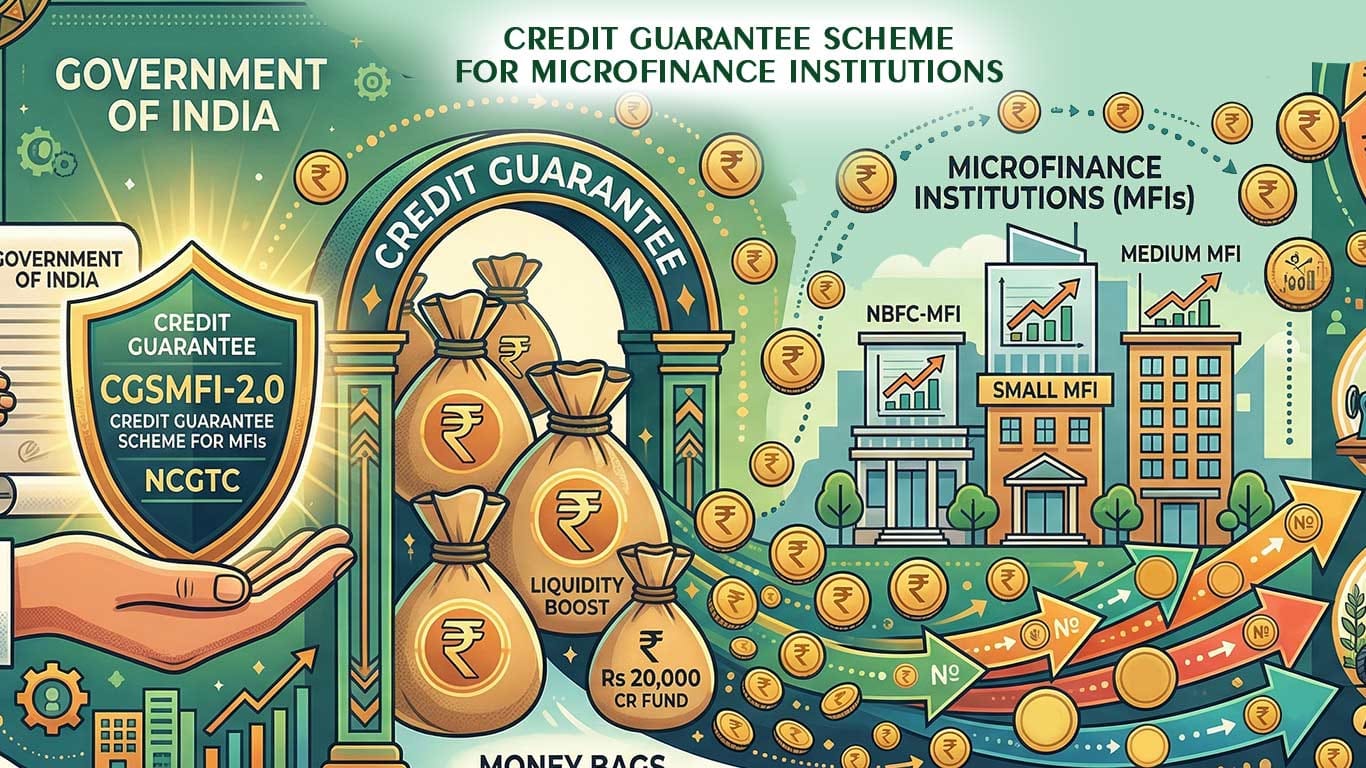


India’s new ₹20,000 crore Credit Guarantee Scheme for Microfinance Institutions (CGSMFI-2.0) is unlikely to ease funding woes for smaller, lower-rated MFIs, as banks remain cautious and prefer lending to financially stronger players. This selective approach could limit the scheme’s reach among stressed micro lenders.
Credit Guarantee Scheme Faces Uneven Impact On Microfinance Sector
The government’s recently launched ₹20,000 crore Credit Guarantee Scheme for Microfinance Institutions (CGSMFI-2.0) aims to boost liquidity and revive lending in the sector. Announced on March 20, 2026, the initiative provides sovereign-backed guarantees to encourage banks and financial institutions to extend loans to microfinance companies. While designed to support financial inclusion and strengthen rural credit, experts caution that its effectiveness may be uneven, as lenders are expected to favor financially stronger MFIs with robust credit ratings.
Scheme Overview
CGSMFI-2.0 covers loans disbursed by banks and financial institutions to NBFC-MFIs and other micro lenders. The scheme will remain in force until June 30, 2026, or until guarantees worth ₹20,000 crore are issued. The National Credit Guarantee Trustee Company (NCGTC) will provide guarantee cover against expected losses, offering partial protection to lenders.
Challenges For Lower Rated MFIs
Despite the sovereign guarantee, banks are unlikely to compromise underwriting standards. Smaller, stressed institutions may still struggle to access funds, as lenders prioritize risk management over inclusivity. This could undermine the scheme’s broader goal of ensuring liquidity across the microfinance ecosystem.
Key Highlights
-
Scheme size: ₹20,000 crore sovereign-backed guarantee
-
Duration: March 20 – June 30, 2026, or until limit exhausted
-
Coverage: Loans to NBFC-MFIs and MFIs for on-lending to small borrowers
-
Guarantee provider: National Credit Guarantee Trustee Company (NCGTC)
-
Concern: Lower-rated MFIs may remain excluded despite partial protection
Outlook
The scheme is expected to strengthen well-rated MFIs and improve credit flow to millions of small borrowers. However, unless banks extend support beyond top-tier institutions, weaker MFIs may continue to face liquidity stress, limiting the scheme’s overall impact on financial inclusion.
Sources: The Financial Express, Outlook Business, BW Businessworld, Press Information Bureau, Telegraph India, The Economic Times