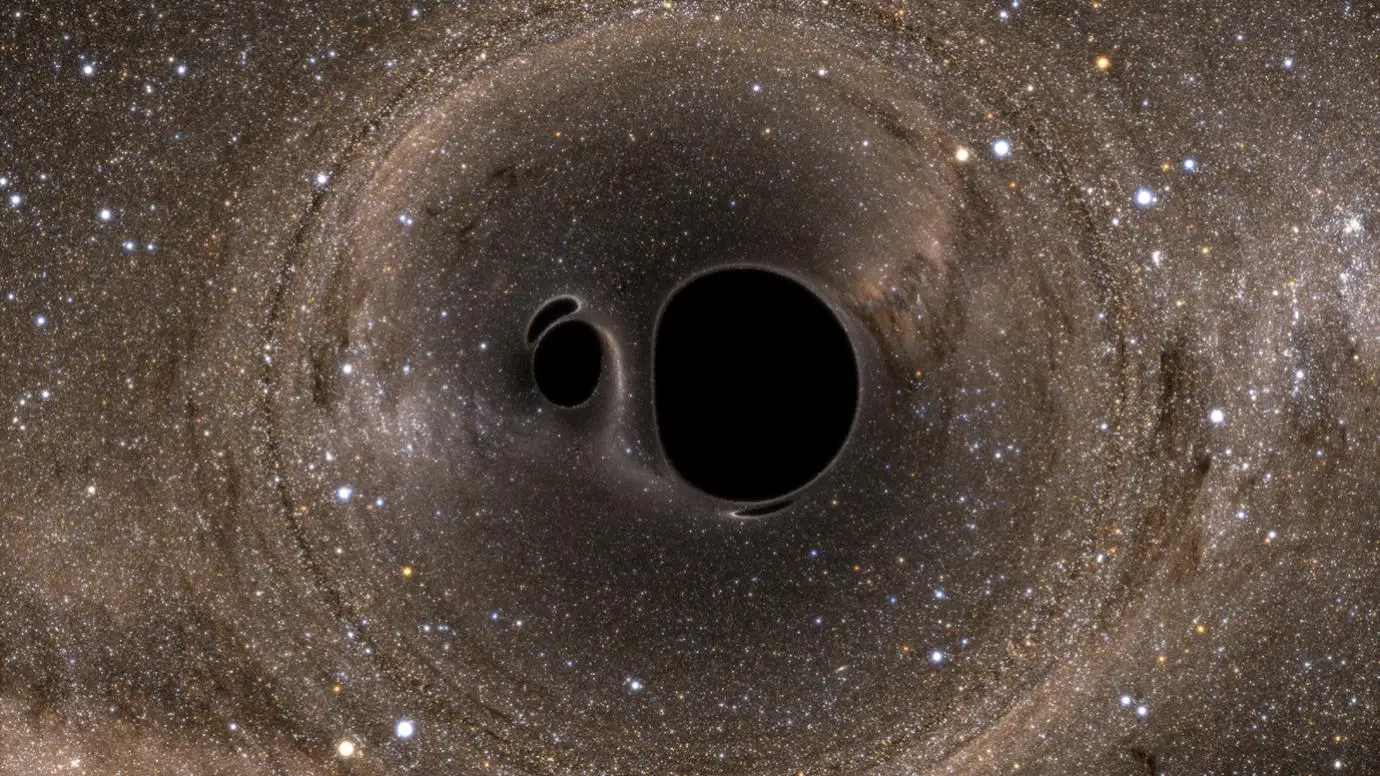




Astronomers have directly observed a spinning black hole twisting spacetime, a phenomenon predicted by Albert Einstein more than 100 years ago. The rare event, triggered by a star’s destruction, provides the first clear evidence of Lense-Thirring precession and validates general relativity under extreme cosmic conditions.
In a breakthrough that bridges theory and observation, astronomers have captured the first direct evidence of spacetime twisting near a spinning black hole. This phenomenon, known as Lense-Thirring precession, was predicted by Albert Einstein in his theory of general relativity but had never been witnessed so clearly until now.
The discovery unfolded during a tidal disruption event (TDE) labeled AT2020afhd, when a star strayed too close to a supermassive black hole. The star was torn apart, forming a glowing disk and powerful relativistic jets. These jets and the disk began to wobble rhythmically, revealing spacetime itself being dragged and twisted by the black hole’s immense spin.
Key Highlights
-
Spacetime Twist Observed: Astronomers saw spacetime wobble near a spinning black hole for the first time, confirming Einstein’s prediction.
-
Triggered By Stellar Destruction: The phenomenon was detected during a tidal disruption event where a star was shredded by a supermassive black hole.
-
Evidence Of Lense-Thirring Precession: The rhythmic wobble of the disk and jets provided direct proof of spacetime dragging, a rare cosmic effect.
-
Published In Science Advances: The findings were formally documented, marking a milestone in astrophysics and relativity research.
-
Extreme Validation Of Relativity: The observation confirms Einstein’s theory under conditions of immense gravity and spin, strengthening its universal applicability.
This cosmic spectacle not only validates a century-old theory but also opens new avenues for studying black holes and the fundamental nature of spacetime. By observing such rare events, scientists gain deeper insights into how gravity and relativity operate in the universe’s most extreme environments.
Sources: SciTechDaily, The Daily Galaxy, International Business Times UK