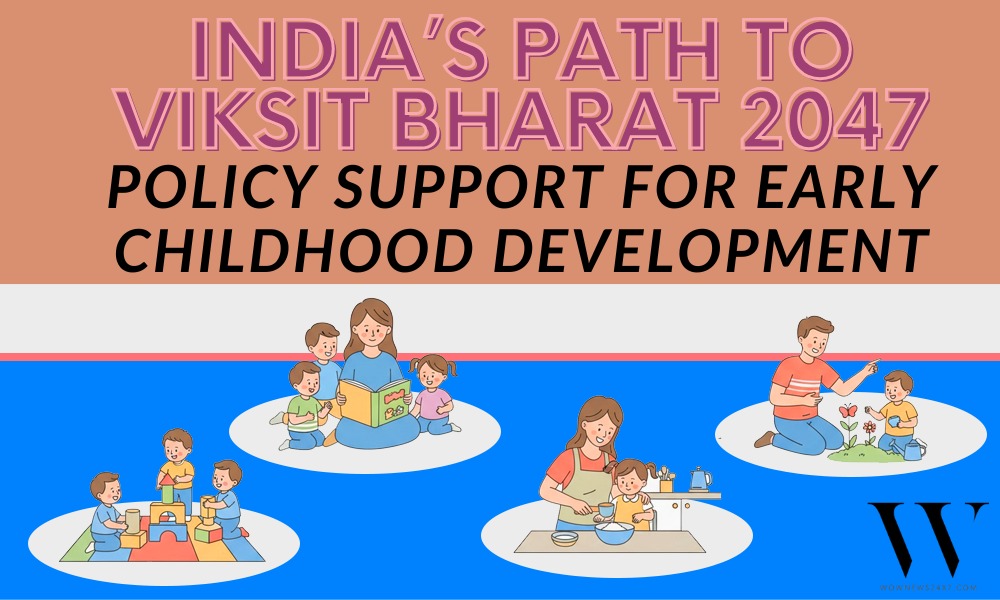





Early Childhood Education and Development (ECED) is the foundation of human capital growth. India needs extensive policy support to expand access, improve quality, and integrate health, nutrition, and education. Strong investment in ECED yields high returns, reduces inequality, and aligns with India’s vision of becoming Viksit Bharat by 2047.
Key Highlights
-
Economic Logic: Nobel laureate James Heckman’s research shows every dollar invested in ECED yields a 7x return on investment.
-
Current Gaps: India’s ECED policies remain fragmented, with limited coordination between health, nutrition, and education services.
-
National Priority: ECED is critical for Viksit Bharat 2047, ensuring inclusive growth and reducing intergenerational poverty.
-
Policy Needs: Stronger frameworks, higher budget allocations, and quality teacher training are essential.
-
Global Lessons: Countries with robust ECED policies show better workforce productivity and social equity.
Context & Implications
India’s Integrated Child Development Services (ICDS) and the National Education Policy (NEP 2020) recognize ECED, but implementation challenges persist. Low enrolment, uneven quality, and inadequate infrastructure hinder progress. Experts argue that policy convergence across ministries, public-private partnerships, and community-based models are needed to scale impact.
Investing in ECED is not just social policy—it is economic strategy. Studies show that children with access to quality early education perform better academically, earn higher incomes, and contribute more productively to society. For India, this means breaking cycles of poverty, empowering women through workforce participation, and preparing a future-ready generation.
Risks if Neglected
-
Widening inequality between urban and rural children.
-
Poor learning outcomes in primary education.
-
Reduced workforce competitiveness in global markets.
-
Missed demographic dividend as India’s young population ages without adequate skills.
Actionable Recommendations
-
Increase ECED budget allocations under education and social welfare.
-
Train and certify early childhood educators nationwide.
-
Integrate health, nutrition, and education services for holistic child development.
-
Leverage technology for monitoring and scaling ECED programs.
-
Encourage private sector and NGO partnerships to expand reach.
Sources: Hindustan Times (Mar 10, 2026, authored by Gopal Naik & Anjana Dube, IIM Bangalore), Journal of Advance and Future Research (2025), Government of India policy documents