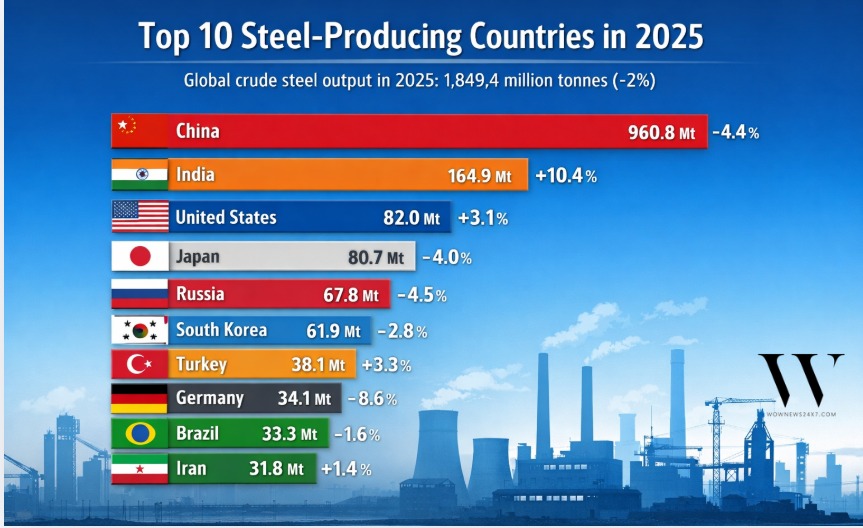

Global crude steel production in 2025 reached 1,849.4 million tonnes, marking a 2% decline from the previous year. China remained the dominant producer with 960.8 million tonnes, but India’s rapid growth to 164.9 million tonnes highlighted a shifting balance in global steel supply and demand.
Global Steel Industry Overview
Steel continues to be the backbone of infrastructure, construction, automotive, and manufacturing industries worldwide. The World Steel Association’s latest figures reveal both resilience and challenges in the sector. While China still accounts for more than half of global output, India’s double-digit growth underscores its rising influence in global trade and industrial expansion.
Country-Wise Performance
- China led the rankings with 960.8 million tonnes, though production fell by 4.4% due to capacity discipline and weaker demand.
- India surged 10.4% to 164.9 million tonnes, driven by government-backed infrastructure projects and strong domestic consumption.
- The United States produced 82 million tonnes, up 3.1%, while Japan followed with 80.7 million tonnes, reflecting a 4% decline.
- Russia and South Korea also recorded contractions, producing 67.8 and 61.9 million tonnes respectively.
- Türkey posted growth at 38.1 million tonnes.
- Germany saw the steepest decline at 34.1 million tonnes, down 8.6%.
- Brazil and Iran rounded out the top 10 with 33.3 and 31.8 million tonnes respectively.
Regional Trends And Market Insights
India’s rise as the second-largest producer signals its growing role in global supply chains, particularly as demand for steel in infrastructure and housing continues to expand. China’s slowdown reflects a shift toward sustainability and efficiency, while Germany’s decline highlights the impact of energy costs and industrial challenges. The U.S. and Türkiye’s modest gains suggest stable demand and modernization efforts.
Industry Significance
The steel industry remains a key indicator of economic health. India’s growth trajectory positions it as a critical player in shaping future supply chains, while China’s dominance, though slowing, continues to influence global pricing and trade flows. For investors and policymakers, these rankings highlight where opportunities and risks lie in the evolving industrial landscape.
Key highlights
- Global steel output in 2025 stood at 1,849.4 million tonnes, down 2%
- China leads with 960.8 million tonnes despite a 4.4% decline
- India surges 10.4% to 164.9 million tonnes, fastest growth globally
- U.S. and Türkiye post modest gains, showing stable demand
- Japan, Russia, South Korea record declines amid global pressures
- Germany sees steepest fall at −8.6% due to energy costs
- Brazil and Iran remain steady contributors to global steel supply
Sources: World Steel Association, ScrapMonster, IndexBox